On-shore and off-shore Site & Geotechnical Investigation
Welcome to MAS GMTL, a trusted provider of geotechnical investigation services specializing in onshore and offshore drilling, field testing, and comprehensive laboratory analysis. With years of proven expertise and a dedication to quality, we deliver precise, reliable data to support engineering, construction, and environmental projects. Our skilled team employs the latest technologies and methodologies to ensure accurate geotechnical insights—no matter the complexity or scale of your project.
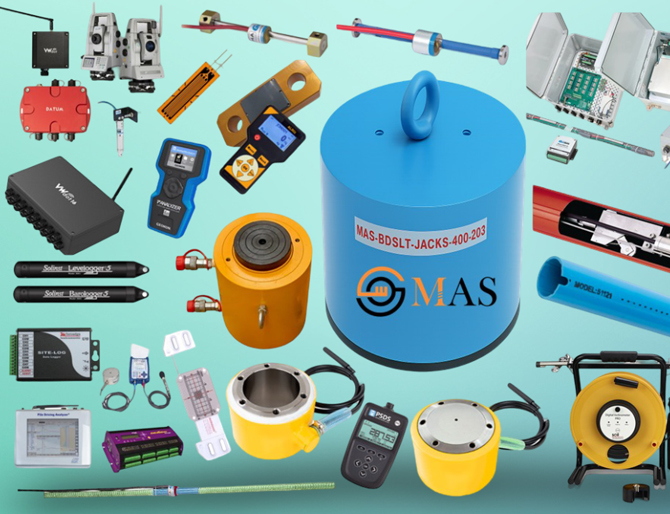
At MAS GMTL, we offer a full suite of in-situ testing services designed to provide critical subsurface data for a wide range of applications. Our capabilities include Cone Penetration Testing (CPT), Packer (Lugeon) Testing, High-Pressure Dilatometer Testing (HPD), Plate Load Tests, Permeability and Pumping Tests, Downhole Seismic Testing, Trial Pit Excavations, In-Situ CBR Tests, and piezometer installations (including Vibrating Wire Piezometers). These methods allow us to accurately assess soil strength, compressibility, permeability, and seismic response, giving clients reliable data for safe and efficient design.
Whether you’re planning major infrastructure, evaluating soil conditions for a new development, or conducting environmental studies, MAS GMTL is your reliable partner for comprehensive geotechnical investigations. Contact us today to discuss your requirements and how we can support your success.
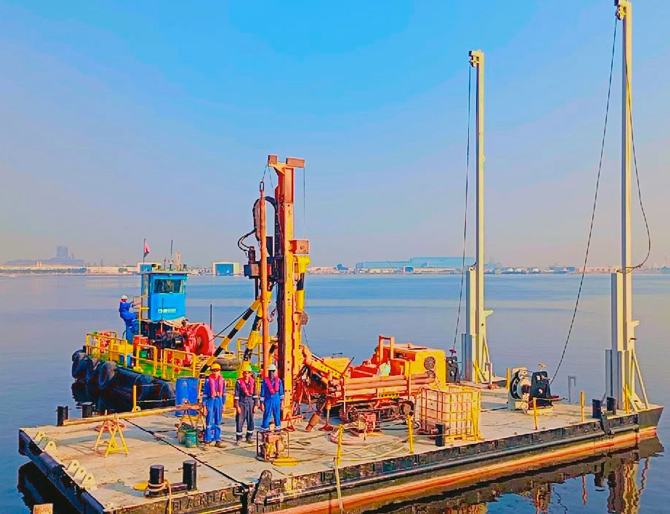
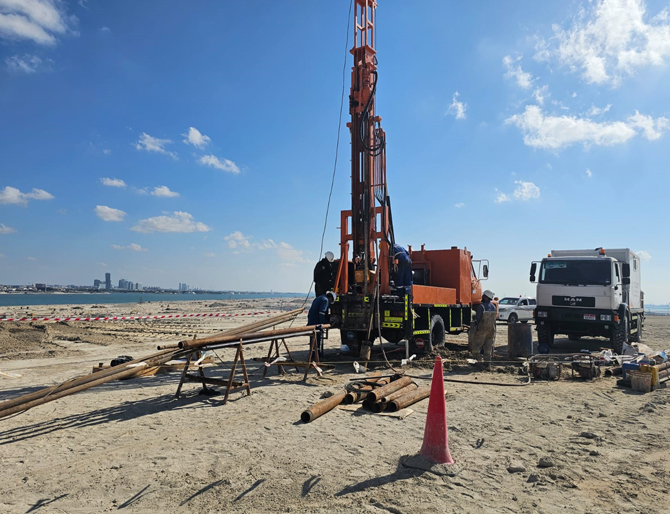
We deliver onshore and offshore drilling services using advanced rigs to execute borehole drilling and retrieve high-quality undisturbed samples. Our operations provide accurate data on soil and rock stratification, bearing capacity, and geotechnical properties, all performed in compliance with ASTM, BS, and international standards.
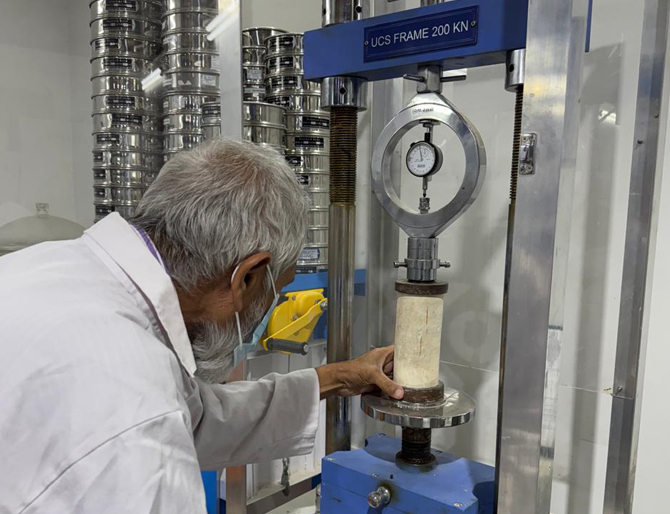
Our geotechnical laboratory provides comprehensive testing to evaluate the physical, mechanical, and chemical properties of soils, rocks, and groundwater. Tests include unconfined compressive strength (UCS), direct shear, triaxial compression, consolidation, grain size analysis, Atterberg limits, density, permeability, and rock point load to assess soil and rock behavior. Chemical testing of soils and groundwater covers pH, electrical conductivity, sulfates, chlorides, organic content, and carbonates. The results support foundation design, slope stability evaluation, and ground improvement programs.
CPT provides continuous, high-resolution profiling of soil stratigraphy and in-situ soil behavior. By measuring tip resistance, sleeve friction, and pore pressure, CPT delivers accurate assessments of soil type, strength, and deformation characteristics. The data is essential for foundation design, settlement evaluation, and ground improvement studies.
Trial pits allow direct visual inspection of shallow subsurface conditions, enabling identification of soil horizons, groundwater levels, and collection of representative samples. They are widely used in preliminary investigations to assess soil variability, potential contamination, and overall site suitability for construction.
HPD testing evaluates the stiffness, deformability, and in-situ compressibility of soil and rock by expanding a pressurized probe within a borehole. The results support accurate assessment of settlement, soil–structure interaction, and the design of deep foundations and heavily loaded structures.
Piezometers are instruments used to measure groundwater levels (water table or piezometric head) within soil or rock. By recording the groundwater level at different depths, piezometer testing helps evaluate subsurface water conditions and how they may influence soil stability and behavior.
This information is essential for assessing slope stability, designing foundations, monitoring dewatering systems, and understanding groundwater fluctuations during construction.
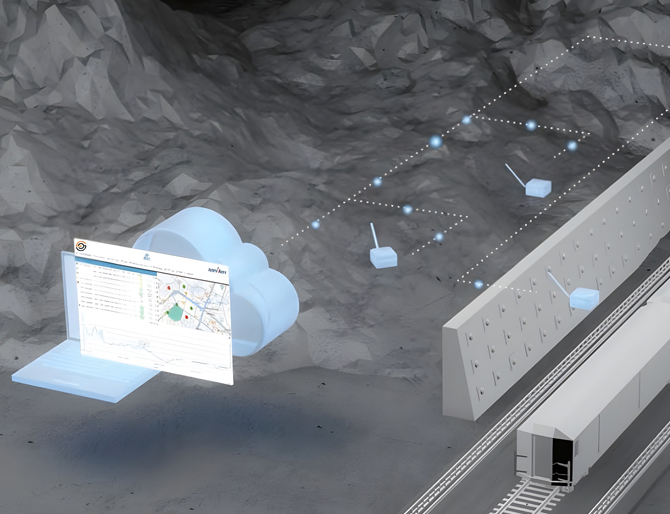
Vibrating Wire Piezometers (VWPs) are high-precision instruments used to measure groundwater levels (piezometric head) and changes in water pressure within soil or rock. Their robust, long-term stable sensors make them suitable for deep installations, harsh environments, and remote monitoring applications.
VWPs are widely used in dam safety monitoring, slope stability assessment, deep excavation projects, and long-term groundwater observation.
Permeability testing, using either the Falling Head or Constant Head method, determines the ease with which water can flow through a soil sample. These tests provide essential information on the soil’s hydraulic conductivity, which is critical for assessing drainage behavior, foundation performance, seepage potential, and the suitability of soils for water retention or infiltration systems.
Packer testing assesses the permeability and hydraulic conductivity of fractured rock and soils. By isolating borehole sections and applying water pressure, the test quantifies leakage rates, supporting dam foundation analysis, tunnel design, and grouting evaluation.
Pumping tests provide detailed insights into aquifer properties, groundwater yield, and borehole performance. By conducting constant-rate or variable-rate pumping, we measure drawdown and recovery rates, enabling assessment of permeability, transmissivity, and groundwater sustainability.
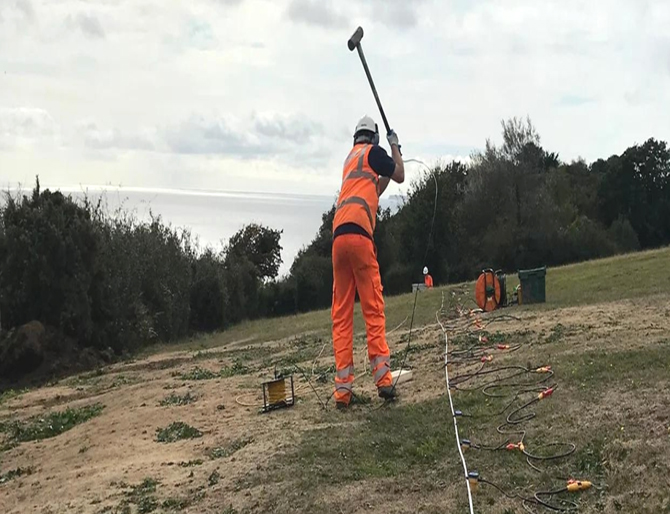
This method measures soil shear-wave velocity (Vs) and compressional-wave velocity (Vp), which are vital for seismic site classification and dynamic response analyses. Downhole seismic data is critical for earthquake engineering, soil-structure interaction studies, and foundation design in seismic zones.
The in-situ CBR test evaluates soil strength and load-bearing capacity, particularly for roads, runways, and pavements. By measuring penetration resistance, the test provides design parameters for subgrades and flexible pavement layers.